
What changed this month
The page the owner reads first: what moved, why, and what happens next month. The finance lead writes this page, because the reasons behind a month are not in the ledger.
Finished monthly report
A monthly financial report is the pack a finance lead sends the owner or the board after the books close: profit and loss, balance sheet and cash flow, against budget and last year. With the reasons behind the numbers added, as here, it is a management report. Below is one finished sample, exported from Reportly. The company, its customers and every figure are invented.
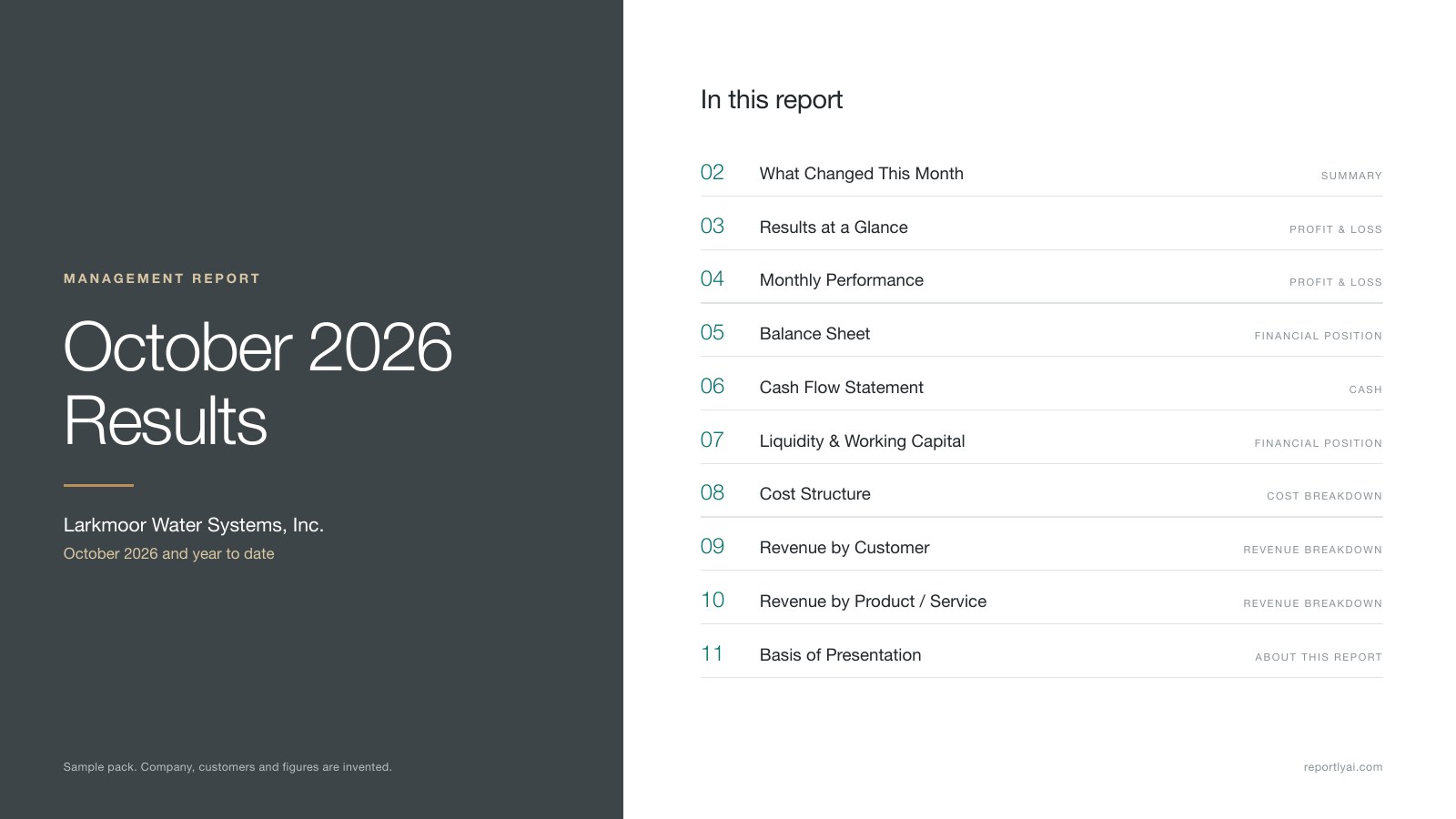
Ten pages after the cover, in the order an owner reads them: first what changed, then the statements, then where the revenue and the costs come from. Select a page to enlarge it. After the pages: what Reportly fills and what you write.
The page the owner reads first: what moved, why, and what happens next month. The finance lead writes this page, because the reasons behind a month are not in the ledger.
Profit and loss for the month and the year to date in one table, against budget and last year, with every variance in dollars and percent. Below it, the bridge from budgeted to actual EBITDA.
Revenue and gross margin month by month against budget, so you can tell one unusual month from a trend. The outlook table shows where the full year lands.
Assets, liabilities and equity against the last year-end, with the change in every line.
From net income to the change in cash, against the same period last year. Closing cash is the cash on the balance sheet.
Current assets and liabilities, the current ratio, receivable days, and the cash walk for the month and the one ahead.
Cost of goods sold and operating expenses by line, as a share of revenue and against budget.
The largest customers, the share of revenue each one carries, and how revenue spreads over customer sizes.
Revenue, units and average price by product, and the trend of each category through the year.
Period, currency, budget version, comparatives, source and the terms used, stated once so no page has to repeat them.
The tables and charts come from the ledger. The reasons come from you. Here is how the work splits when the pack comes from Reportly.
Reportly
Reportly reads the ledger from your accounting system and fills the tables and charts on these pages. Next month the same pages refresh.
Reportly, then you
Under each table Reportly drafts a short comment with AI. You check each draft against the numbers, then keep it, rewrite it or delete it.
You
Why the month went the way it did, and what happens next. No ledger holds that, so the first page stays yours.
Five steps, in the order a finance lead does them every month.
Reconcile the bank and card accounts so the figures do not move after the report goes out.
One month on its own proves almost nothing.
A few lines on what moved, why, and whether it will last.
Write it once you know what the statements say. It is the page the owner reads first.
Consistency is what makes trends visible.
The owner or the board gets it, and reads the first page. The finance person builds it: the controller, the outside accountant or the fractional CFO who closes the books and has to explain the month.
If you are the one who receives the pack, see management reporting software for owners. If you build it, see financial reporting software. More free files are in the template library.
Eleven pages: a cover, one page of commentary on the month, profit and loss against budget and last year, month-by-month performance, the balance sheet, the cash flow statement, liquidity and working capital, cost structure, revenue by customer, revenue by product, and the basis of presentation.
A short summary of the month, the profit and loss statement, the balance sheet and the cash flow statement, each against budget and last year, and a few lines on every movement that matters.
Not quite. A financial report presents the statements. A management report adds what an owner needs to decide: budget comparison, customers, products, cash position and commentary. This sample has both, which is why its cover says management report.
No. The company, its customers and all figures are invented. The statements tie to each other the way real ones do: the balance sheet balances and the cash flow statement ends on the cash in the balance sheet.
The first page is written by the finance lead. The short comments under the tables are drafted by Reportly from the numbers and edited by the finance lead before the pack goes out.
Yes. You can edit every text, label and table row and add pages before you export.
PDF and PowerPoint.
No. The sample is a PDF, the format a finished report goes out in. For spreadsheets you fill in yourself, see the company budget template and the cash flow forecast template.
Yes. Start the trial, connect your accounting system and pick the report. The pages fill with your numbers.
Reporting is $99 a month ($79 a month billed yearly) and includes one company, 3 users and 5 reports set up per company. Planning is $199 a month ($159 yearly) and is coming soon. Extra companies are $59 a month each on Reporting and $99 on Planning, the same price whatever the count. Enterprise is quoted per contract. Every plan starts with a 14-day trial. See pricing
Reportly is built by the team behind Hundred MS, a CFO practice that produces monthly packs, budgets and a weekly cash forecast for its own clients; two of its founders hold the CFA and FRM.
Connect your accounting system and see your own pack. Every plan starts with a 14-day trial.